Lucky Number App
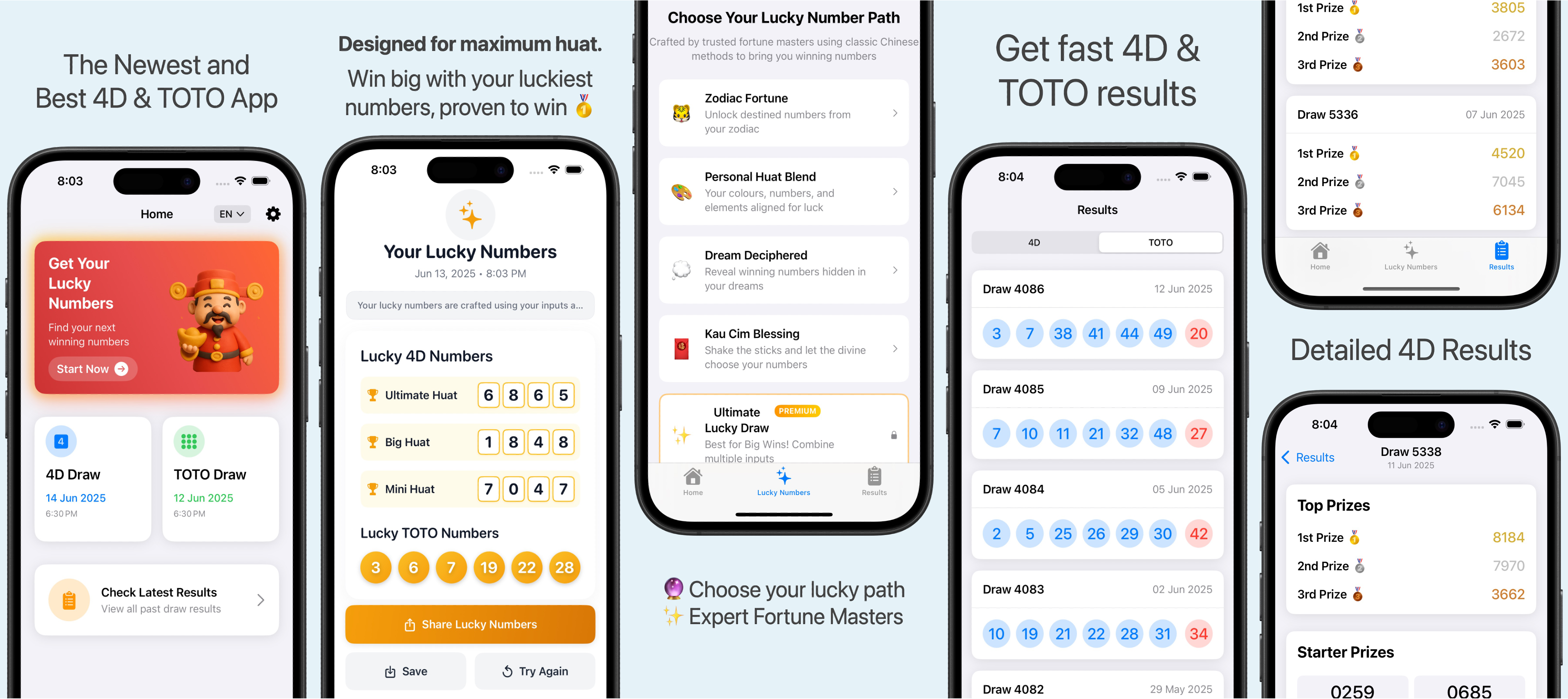
An iOS app for Singapore Pools 4D and TOTO results, with culturally-inspired lucky number suggestions. Try here 🔗
This was not a great project, and here's what I took away from it.
"Existing apps are ugly. I can fix that"
Why are these apps so outdated and uninspired in design, yet have so many reviews?
Along the way, I realised the target audience (older people using these apps) probably don't care because they aren't the type to obsess over good UX - apps simply have to be functional. And they aren't likely to switch apps as long as their current one works.
So nicer UX wasn't really the wedge I thought it was.
"I found a niche. I can win"
I knew it would be futile to try to win the hundreds of lottery result apps in the App Store. This led me to think about where I could actually be useful in a player's day.
Many lottery players don't just pick at random. They draw from dreams, license plates, family birthdates, or visit temples and fortune-tellers. I saw a chance to digitise some of that ritual.
But I didn't manage to crack how to sell this to users. For older, more traditional audiences, a digital experience can never replace the ritual of visiting temples or human fortune tellers. I wanted to bring some of that ritual into a phone, in a lighter form, but I never validated whether anyone actually needed this, older or younger.
- Older users probably won't open a phone app for lucky numbers
- Younger users probably don't want ritualistic lucky numbers in the first place
That said, it was a good experience building and launching an iOS app for the first time. I also made $12 as of press time, so you could say I am now an internet entrepreneur.
Even though the app wasn't going anywhere, I thought it was a good chance to apply some of my learnings from the Reforge Growth Series. I experimented with:
- Acquisition Loop: Shareable number cards designed to be passed around (e.g. "My lucky numbers for the $12M TOTO draw"), branded so people could find the app
- Engagement Loop: Push notifications timed to jackpot draws and cultural dates (e.g. "$12M draw today! Get your lucky numbers now")
Did these work? I'm not sure:
- Shareable number cards: Usage rate was low (<10%)
- Push notifications: The user base was low, so the reach of my notifications was naturally low too. I wouldn't read too much into notification open rates, app usage rates on notification days etc., as it's just not statistically significant.
Update 25/09/25
I finally tried integrating an LLM. It was a great learning experience - I always thought it was just getting the API key and calling it whenever. But once I started integrating, I started thinking about cost, which led me to fine-tuning and evals. I think I did a terrible job because my app AI gives random '5D' suggestions sometimes. I really don't think you can buy that from Singapore Pools but what do I know.
Another interesting exploration was how to handle context, which made me better appreciate consumer-facing LLMs like ChatGPT. I had to find a way to remember context while optimising for cost as well, so that users could have meaningful conversations that did not in essence reset every message. This was particularly difficult but I eventually settled for a lightweight, low cost approach for cheap testing. I never got around to improving it though - usage was also at a bare minimum (though thankfully covered the costs) and logs didn't provide particularly useful usage insights.